SpyGlass User Guide
SpyGlass is a desktop app for managing public and secret contacts, optimised for typing commands while still having a visual display. If you can type fast, SpyGlass handles tasks faster than standard applications.
Quick start
Ensure you have Java 17 or above installed in your computer.
- Mac users: Ensure you have the precise JDK version prescribed here.
Download the latest
.jarfile from here.Copy the file to the folder you want to use as the home folder for SpyGlass.
Open a command terminal,
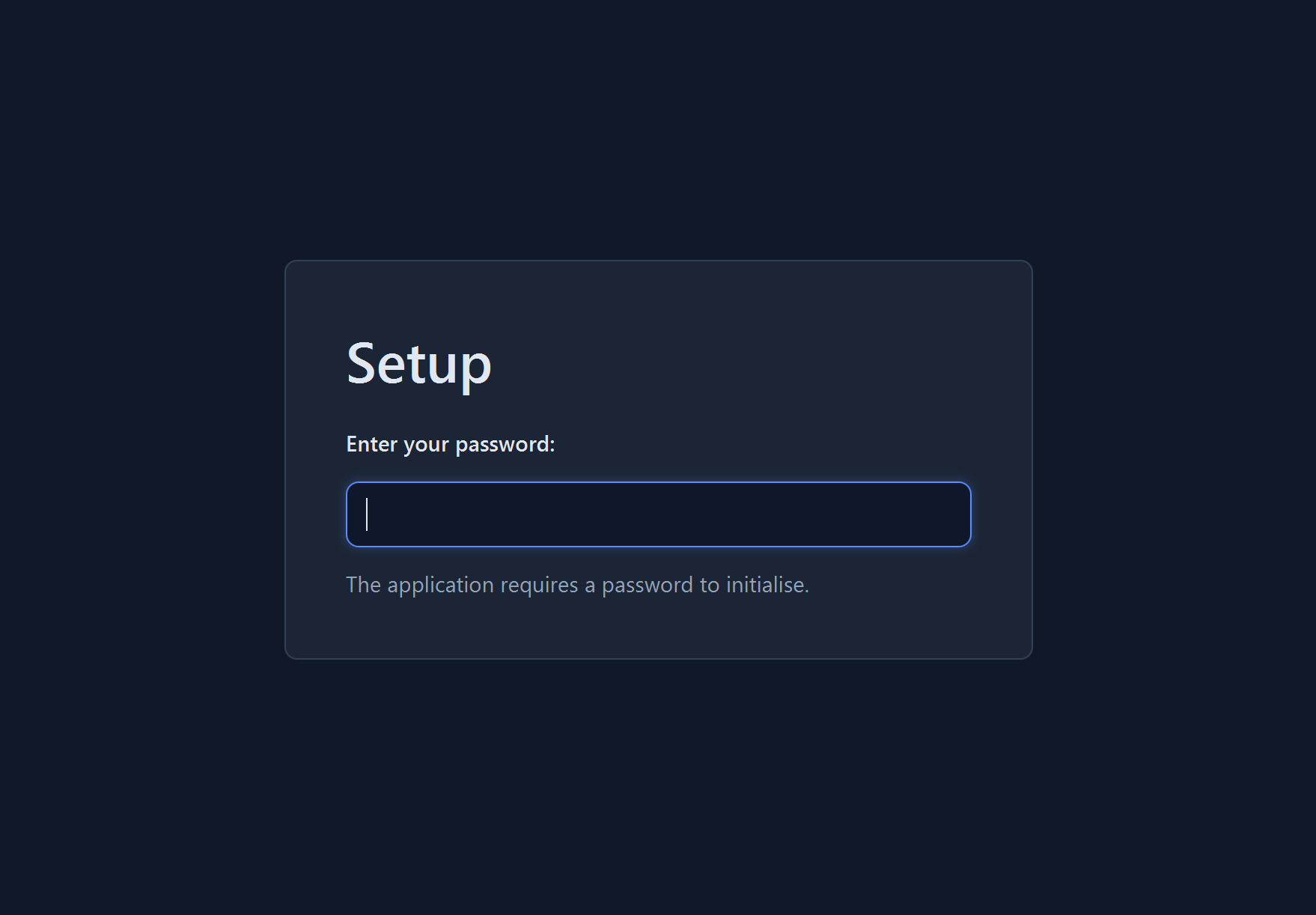
cdinto the folder where you put the jar file, and use thejava -jar SpyGlass.jarcommand to run the application.On your first launch, you will be prompted to secure your data. Enter a password to initialise SpyGlass. Note that your password cannot be empty or contain spaces.
After setting your password, a GUI similar to the image below should appear. Note how the app contains some sample data to help you get started.
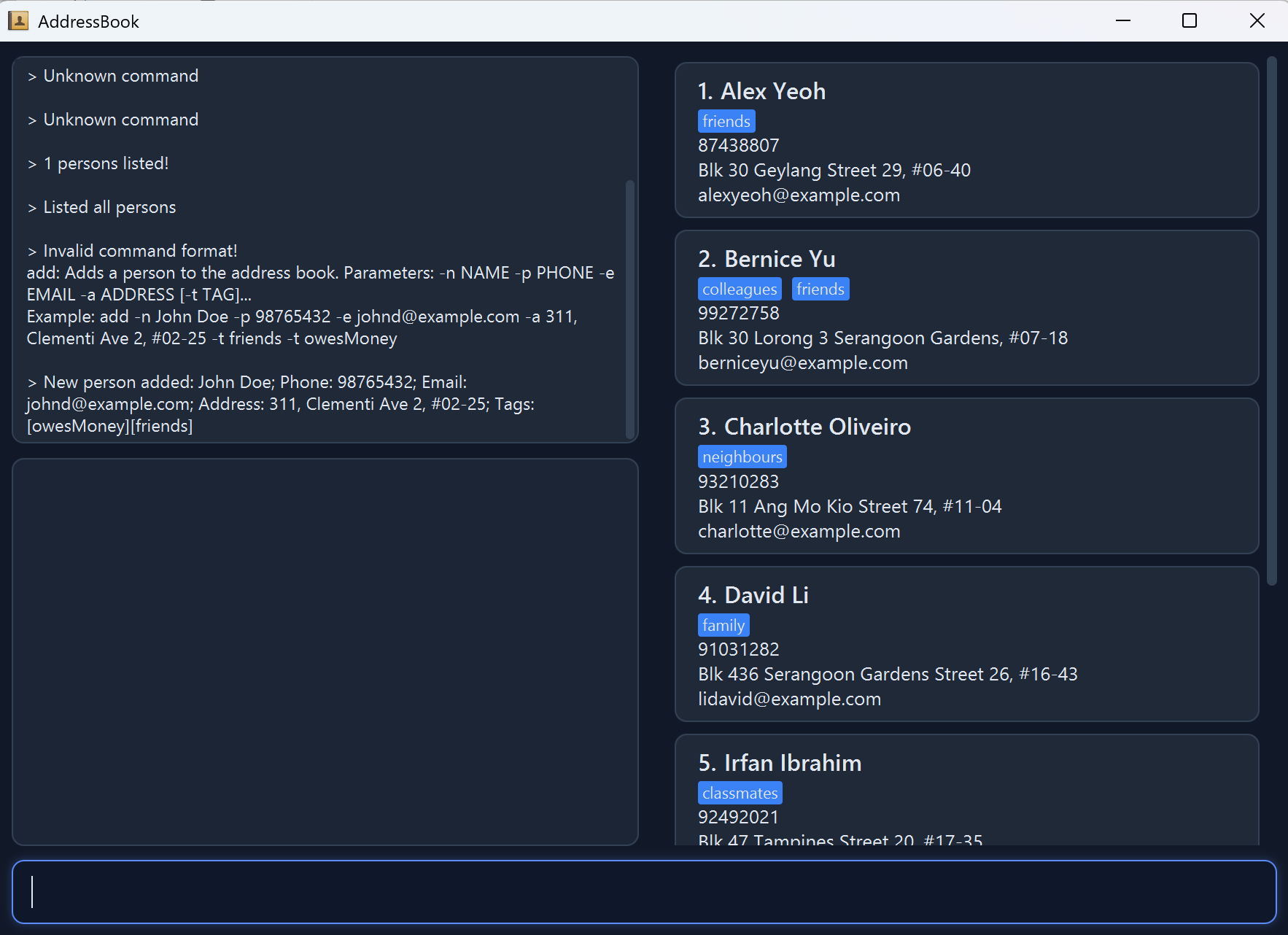
Execute Commands: Type your command in the command box and press Enter to execute it. For example, typing
helpprints the command manual in the command history panel.Try these example commands:
list: Lists all contacts in the current mode.add -n John Doe -p 98765432 -e johnd@example.com -a John street, block 123, #01-01: Adds a contact namedJohn Doe.delete 3: Deletes the 3rd contact shown in the current list.unlock PASSWORD: Unlocks the app to access secured contacts.lock: Locks the app to display only a limited set of public contacts.exit: Exits the app.
Refer to the Features section below for details on every available command.
Features
Notes about the command format:
Words in
UPPER_CASEare the parameters to be supplied by the user.
e.g. inadd -n NAME,NAMEis a parameter which can be used asadd -n John Doe.Items in square brackets are optional.
e.g-n NAME [-t TAG]can be used as-n John Doe -t friendor as-n John Doe.Items with
… after them can be used multiple times including zero times.
e.g.[-t TAG]…can be used as-t friend,-t friend -t familyetc.Parameters can be in any order.
e.g. if the command specifies-n NAME -p PHONE_NUMBER,-p PHONE_NUMBER -n NAMEis also acceptable.Extraneous parameters for commands that do not take in parameters (such as
list,exitandclear) will be ignored.
e.g. if the command specifieslist 123, it will be interpreted aslist.If you are using a PDF version of this document, be careful when copying and pasting commands that span multiple lines as space characters surrounding line-breaks may be omitted when copied over to the application.
App Modes: Locked and Unlocked
SpyGlass has two distinct modes:
- Locked Mode: Displays a public set of contacts. In this mode, the application window displays the name AddressBook to mask its true identity as SpyGlass.
- Unlocked Mode: A private view that displays a hidden set of contacts. Access this mode by entering your password.
Each mode maintains its own separate list of persons. Contacts added in Locked mode will only appear in Locked mode, and contacts added in Unlocked mode will only appear in Unlocked mode.
When you first launch the app, it starts in Locked mode. After password setup, use the unlock command with your password to switch to Unlocked mode.
Command History Display
The Command Display panel keeps a history of past command results.
Unrestricted Commands
Unrestricted commands are the basic functions of SpyGlass that are available in both Locked and Unlocked modes.
Viewing help : help
Shows a concise command manual in the command history panel.
Format: help [COMMAND]
Examples:
helphelp addhelp toggle
Adding a person: add
Adds a person to the address book.
Format: add -n NAME -p PHONE_NUMBER -e EMAIL -a ADDRESS [-t TAG]…
Tip: A person can have any number of tags (including 0)
Examples:
add -n John Doe -p 98765432 -e johnd@example.com -a John street, block 123, #01-01add -n Betsy Crowe -t friend -e betsycrowe@example.com -a Newgate Prison -p 1234567 -t criminal
Listing all persons : list
Shows a list of all persons in the address book.
Format: list
Editing a person : edit
Edits an existing person in the address book.
Format: edit INDEX [-n NAME] [-p PHONE] [-e EMAIL] [-a ADDRESS] [-t TAG]…
- Edits the person at the specified
INDEX. The index refers to the index number shown in the displayed person list. The index must be a positive integer 1, 2, 3, … - At least one of the optional fields must be provided.
- Existing values will be updated to the input values.
- When editing tags, the existing tags of the person will be removed i.e adding of tags is not cumulative.
- You can remove all the person’s tags by typing
-twithout specifying any tags after it.
Examples:
edit 1 -p 91234567 -e johndoe@example.comEdits the phone number and email address of the 1st person to be91234567andjohndoe@example.comrespectively.edit 2 -n Betsy Crower -tEdits the name of the 2nd person to beBetsy Crowerand clears all existing tags.
Locating persons by name: find
Finds persons whose names contain any of the given keywords.
Format: find KEYWORD [MORE_KEYWORDS]
- The search is case-insensitive. e.g
hanswill matchHans - The order of the keywords does not matter. e.g.
Hans Bowill matchBo Hans - Only the name is searched.
- Only full words will be matched e.g.
Hanwill not matchHans - Persons matching at least one keyword will be returned (i.e.
ORsearch). e.g.Hans Bowill returnHans Gruber,Bo Yang
Examples:
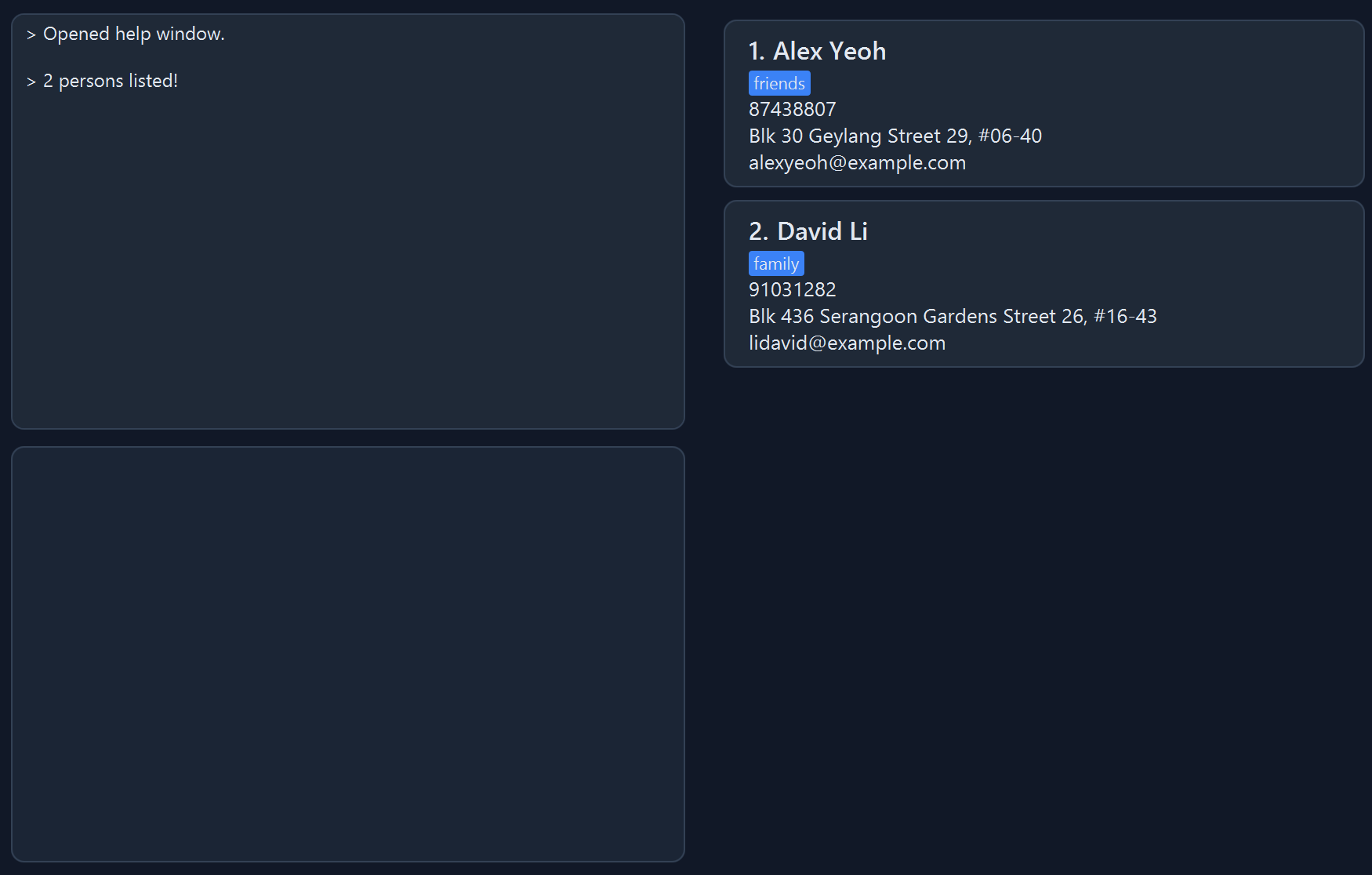
find JohnreturnsjohnandJohn Doefind alex davidreturnsAlex Yeoh,David Li
Deleting a person : delete
Deletes the specified person from the address book.
Format: delete INDEX
- Deletes the person at the specified
INDEX. - The index refers to the index number shown in the displayed person list.
- The index must be a positive integer 1, 2, 3, …
Examples:
listfollowed bydelete 2deletes the 2nd person in the address book.find Betsyfollowed bydelete 1deletes the 1st person in the results of thefindcommand.
Clearing all entries : clear
Clears all entries from the address book.
Format: clear
Exiting the program : exit
Exits the program.
Format: exit
Restricted Commands
Restricted commands are mode-dependent, whose availability changes based on whether SpyGlass is in Locked or Unlocked mode.
Note: When the app is in Locked mode, entering a restricted command incorrectly will result in an Unknown command message. This is intentional to mask the app's capabilities from unauthorized users.
Locking the app : lock
Locks the app and switches to Locked mode, displaying only the contacts in the Locked mode list.
Format: lock
Example:
lock: Locks the app and displays the limited contact list.
Unlocking the app : unlock
Unlocks the app and switches to Unlocked mode by verifying your password. This command displays the list of contacts in the Unlocked mode list.
Format: unlock PASSWORD
- You must provide the correct password that was set during the initial setup.
- If the password is incorrect, the app will remain locked.
Examples:
unlock mySecurePassword123: Unlocks the app with the provided password.
Toggling a contact status : toggle
Toggles the specified contact between Public and Sensitive.
Format: toggle INDEX
- Toggles the contact at the specified
INDEX. - The index refers to the index number shown in the displayed person list.
- The index must be a positive integer
1, 2, 3, ... - This command is only available in Unlocked Mode.
- A contact toggled to
Sensitivewill no longer appear in Locked Mode. - A contact toggled to
Publicwill appear in Locked Mode.
Examples:
toggle 1: Toggles the 1st contact's status.
Saving the data
SpyGlass data are saved in the hard disk automatically after any command that changes the data. There is no need to save manually.
Editing the data file
SpyGlass data for unlocked and locked modes are saved automatically as a JSON file [JAR file location]/data/addressbook.json. Advanced users are welcome to update data directly by editing that data file.
The file stores the contact data at the top, followed by your password.
Caution:
If the password field is missing, empty or contains spaces, the app will prompt you to set a password again when you next open it.
If your changes to the data file makes its format invalid, SpyGlass will discard all data and start with an empty data file at the next run. Hence, it is recommended to take a backup of the file before editing it.
Furthermore, certain edits can cause the SpyGlass to behave in unexpected ways (e.g., if a value entered is outside the acceptable range). Therefore, edit the data file only if you are confident that you can update it correctly.
FAQ
Q: How do I transfer my data to another Computer?
A: Install the app in the other computer and overwrite the empty data file it creates with the file that contains the data of your previous SpyGlass home folder.
Known issues
- When using multiple screens, if you move the application to a secondary screen, and later switch to using only the primary screen, the GUI will open off-screen. The remedy is to delete the
preferences.jsonfile created by the application before running the application again.
Command summary
| Action | Format, Examples |
|---|---|
| Add | add -n NAME -p PHONE_NUMBER -e EMAIL -a ADDRESS [-t TAG]… e.g., add -n James Ho -p 22224444 -e jamesho@example.com -a 123, Clementi Rd, 1234665 -t friend -t colleague |
| Clear | clear |
| Delete | delete INDEXe.g., delete 3 |
| Edit | edit INDEX [-n NAME] [-p PHONE_NUMBER] [-e EMAIL] [-a ADDRESS] [-t TAG]…e.g., edit 2 -n James Lee -e jameslee@example.com |
| Find | find KEYWORD [MORE_KEYWORDS]e.g., find James Jake |
| List | list |
| Lock | lock |
| Toggle | toggle INDEXe.g., toggle 1 |
| Unlock | unlock PASSWORDe.g., unlock mySecurePassword123 |
| Help | help [COMMAND]e.g., help add |
Availability Table for Restricted Commands
| Command | Available In |
|---|---|
unlock | Locked Mode |
lock | Unlocked Mode |
toggle | Unlocked Mode |